The Phoenix Always Rises
Partnering with Resurgent Industries

“If we don’t make stuff, there’s no stuff.”

— Elon Musk
Andy Grove’s Premonition
The right idea, applied the incorrect way, is just as bad as the wrong idea. In other words, context really matters. The less you know, the harder it is to win.
Let me give you an example. From Patrick McGee‘s Apple in China:
During his years in exile, Steve Jobs held firm to his original belief that controlling the hardware meant building it. At NeXT, he once said his favorite thing about the computer was that “it’s not made in Osaka.”
Steve Jobs was right. But he was also wrong.
But Apple was strapped for cash, operations had been significantly downsized, and the company lacked the capability or expertise to build a cathode ray tube, or CRT, the monitor the computer was built around.
The right idea, but an inability to effectuate it.
How could one of the most successful companies in the history of the world fail to build the thing they themselves designed?
We kind of already know the answer, and if you don’t then the title of the book above should make it pretty obvious. The U.S. manufacturing base has hollowed out over the past few decades. There are endless articles, essays, and posts about it.
We don’t need to rehash that all out here. What’s more important is the fact that offshoring was originally celebrated. It promised better margins, return on equity, and efficiency. All of those can be good, but they can also be taken too far. Only a few people understood the consequences of what that would mean. McGee highlights one person in particular who saw where this was going:
The cofounder of Intel, Andy Grove, would later diagnose the problem as “a general undervaluing of manufacturing—the idea that as long as ‘knowledge work’ stays in the US, it doesn’t matter what happens to factory jobs.”
But as Grove warned: “our pursuit of our individual businesses, which often involves transferring manufacturing and a great deal of engineering out of the country, has hindered our ability to bring innovations to scale at home. Without scaling, we don’t just lose jobs—we lose our hold on new technologies. Losing the ability to scale will ultimately damage our capacity to innovate.”
Two months after Grove originally gave this speech, a White House economics advisor said: “I think outsourcing is probably a plus for the economy in the long run.”
Grove fired back:
“I disagree. Not only did we lose an untold number of jobs, we broke the chain of experience that is so important in technological evolution. As happened with batteries, abandoning today’s “commodity” manufacturing can lock you out of tomorrow’s emerging industry.”
We spent the last few decades abandoning these commodities, but now we’re coming back for them.
The Building Blocks
The other week we wrote about why we love commodities.
We’re betting on the idea that new commodity companies will in fact be attractive investments. Massive ones. Precisely because they use technology to arrive at a fundamentally superior cost profile.
We call these Advantaged Commodity Companies (ACCs), and they’re one of the investment areas we’re most excited about.
Advantaged Commodity Companies do 3 things: They use hardware to make products and processes better, faster, and cheaper; they use software & AI to automate and orchestrate their processes; and they use vertical integration to accordion costs down.
The end result is a company that produces better products, for cheaper, and does so in a way that’s counter positioned to the incumbents. It’s structurally distinct enough that incumbents cannot copy their methods.
Commodities are the foundational building blocks that everything else in society is built off of. They’re difficult to operate in, precisely because they require scale, scale, and more scale.
That brings us back to Andy Grove. He, more than most, fully understood the benefits of scale. Intel ascended to new heights under his leadership thanks in large part to this acute awareness.
The throughline between Grove’s comments and our Advantaged Commodities thesis is that for the vast majority of commodity products, we have lost our ability to compete on the core building blocks that feed into the rest of the physical world. And if we’re serious about reindustrialization, then we need to be able to build, fashion, and deliver these products ourselves. And do it in a way where we win on cost. The only way to do that is to revisit these industries with a fresh set of eyes; we need to reimagine everything from first principles.
We have many companies doing this, and we’re excited to finally announce another one that falls in our ACC thesis.
Time for Resurgence
At the beginning of the year we led the preseed round for Resurgent Industries.
Resurgent’s mission is to make American manufacturing economically inevitable. They want to produce many of the key building blocks we need to survive and thrive.
They’re tackling that problem in a very Cantos way: they’re producing a good that sneakily commands hundreds of billions of TAM by using a clever mix of process enhancement, automation, and talented battle-tested engineers. They’re a true embodiment of the ACC thesis.
The intent is to build a network of modern automated factories that produce the raw inputs that the rest is society needs. The strategy of how they do that should look familiar.
Textiles: The Tip of the Spear
Similar to Amazon, Resurgent is Threading the Needle: starting with textiles, and expanding beyond that over time.
The strategy is rooted in Amazon’s ascension: understand the grand vision, identify the ideal beachhead market, and execute to build a viable initial business that lends itself to stepping into the bigger vision.
Beachhead selection is essential because if done right it guarantees that your initial business will be self-sufficient and the cash flow that comes will be used to initiate expansion.
Amazon started with books for a whole litany of reasons. That put them in a position to naturally expand into other product adjacencies, and quite literally build the business from A to Z.
Resurgent industries is taking a similar approach for commodities. The reasoning behind their initial beachhead is going to be held close to their chest right now, though the company will share more about their vision soon.
It’s Time to Just Do It
We hear (and write!) a lot about how it’s time to build, how it’s time to reshore and restore. That’s all well and good, but I keep thinking of Tim Grover, Michael Jordan and Kobe Bryant’s elite trainer:
You can’t win by simply absorbing thoughts about Winning. You have to release real energy and perform the action of Winning. It won’t grow on its own, it needs your investment and commitment—it needs everything—to grow. You have to take the risk and the action and feel it.
Tim S. Grover, Winning
In other words, the only way to actually do this is to just go out and do it. Otherwise you won’t get anywhere.
In that vein, we are going to heed that advice and withhold from sharing much more about Resurgent’s specific approach. It’s challenging to write about companies this way, but this team doesn’t need to talk loudly about what they’re going to do. They’d rather just go out and do it.
And we feel pretty good about the team at the helm.
Derek and ‘Delta Team’
Resurgent is led by Derek Stephens.
Derek was employee #6 at K2 Space, where he built their supply chain from scratch. Before that, he spent over six years between SpaceX and The Boring Company, working on supply chain for Falcon 9, Falcon Heavy, and Starlink, and production for Raptor. And he helped lead production at Boring.

As we referenced Derek across our network, the feedback was consistent and enthusiastic. He has a long track record of delivering results; he is utterly dependable, which explains his rapid expansion of responsibilities at each organization he joined.
Outside of these accomplishments, we saw even more. Derek is a true “Kool-Aid Man” as we like to say: he will run through walls and get his sledgehammer on. We’ve heard story after story about him solving herculean tasks. A rabid problem solver and executor, he is unfazed by the critical path. He approaches everything with enthusiasm.
Derek is also impressively methodical and intentional. Intentionality is essential in these categories; it’s a great proxy of judgement. Over the course of their journey, founders will take in millions of data points, process them, and make decisions. We’ve already seen this up close in action with Derek.
But perhaps Derek’s two most notable traits are his infectious energy and gravity of presence. You get all of his attention, and that attention is buoyant, bright, and elevating. This has manifested in one of the fastest hiring paces in the history of our portfolio.
Derek has a rare talent gravity that we look for — the ability to pull exceptional people into orbit around a shared mission before there’s even an office or product.
When he was ready to start Resurgent, Derek already had several of his former colleagues primed and ready to join. What surprised us was the pace at which he continued to land key hires. Derek has assembled an elite team of 18+ less than a few months of us backing him. It speaks to his leadership, his camaraderie with former colleagues, and his ability to energize people and get them excited about the mission.
We think of this team of 18+ as ‘Delta Force’ for manufacturing. People like Brian Josel, Joe Heareth, Will Hong, Chris Hammel, Megan Wheeler, Loc Nguyen, Kevin Mechler, Sergio Martinez, and more. They hail from every part of the ADCU, and collectively they form one of the most talented teams in their pocket of the industrial base.
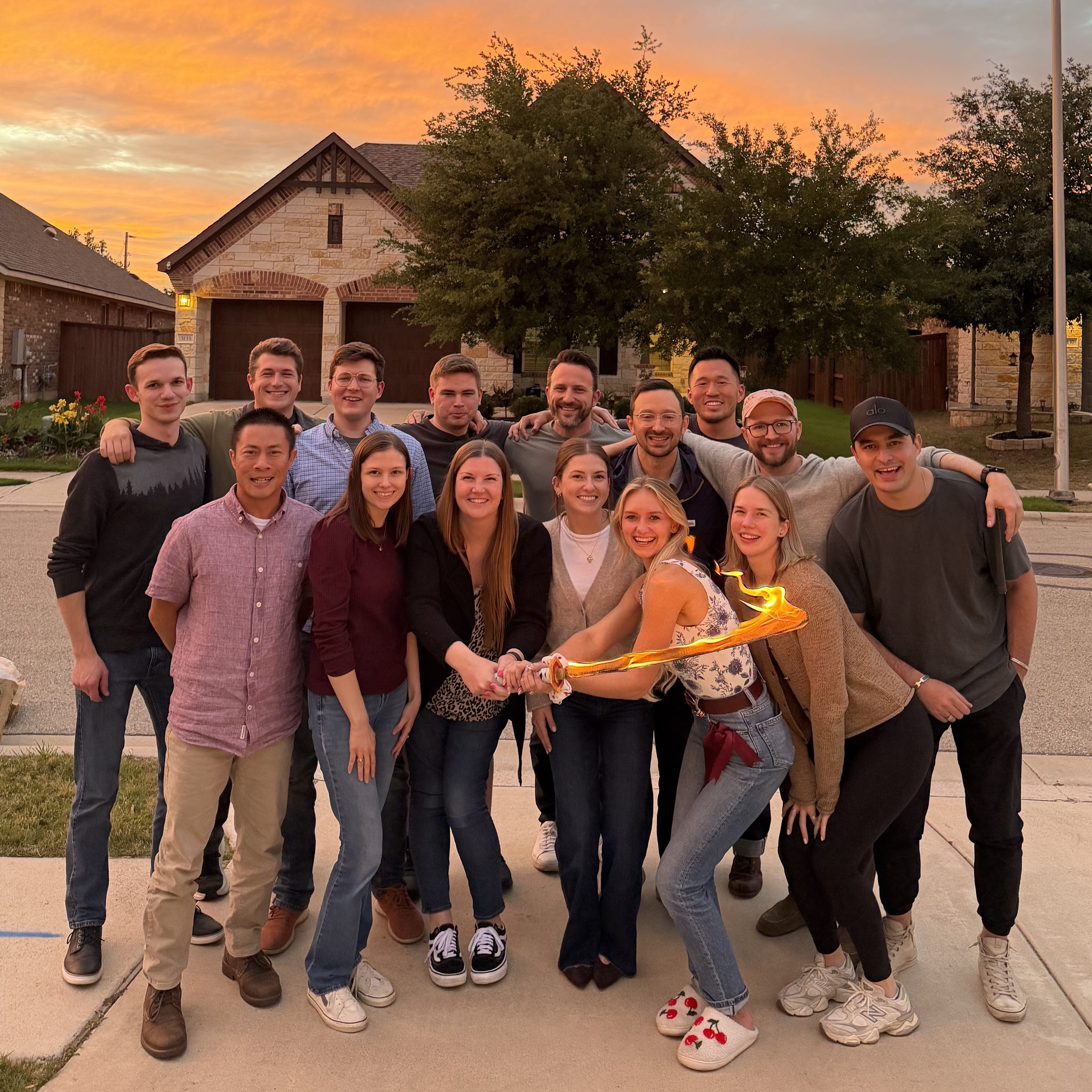
Resurgent is HQ’d in Austin, where there is a rich existing network of people in the textile industry. We are hiring!
This is a special group that has massive aspirations, and we believe in what they can accomplish. We’re thrilled to finally announce our partnership with the Resurgent team. We’re also excited to be working with our friends at Generational Partners, Riot, Forward Deployed, and Lux Capital.

The Phoenix
When we first met Derek, he had already decided to name the company Resurgent, but we didn’t realize what the logo would be. It turns out it’s a phoenix, and as we’ve worked with him and the team, we can’t think of a more perfect logo to embody the mission for this company.
The phoenix is a powerful thing. Importantly, it’s a creature that’s much stronger than its original form. The West should not aspire to return to its former might on the manufacturing side. Instead it should focus on ascending beyond its former peak and becoming something even better.
China and other emerging countries leapfrogged past the West on a number of technologies the last few decades, precisely because they were previously behind. China skipped laptops and went straight to smartphones. The same applies to manufacturing electric vehicles, robots, and more. China still can’t make great internal combustion engine vehicles, but that doesn’t matter if other technologies looks more like smartphone manufacturing.
The path for U.S. industrial resurgence is through leapfrogging to new forms of manufacturing, chiefly enabled by all the advancements that have come to bear in the last few decades. When you reimagine these industries from first principles, it allows you to question a lot of inherited assumptions and focus on specific angles of attack for how you can deliver costs savings.
We have the right ideas, and now it’s a matter of executing against them.
Steve Jobs and Andy Grove were right. Controlling the future means building it. And now it’s our turn to make sure we can actualize the vision.
“Rise.” — The Dark Knight Rises